The Quietest Dominance in World Football
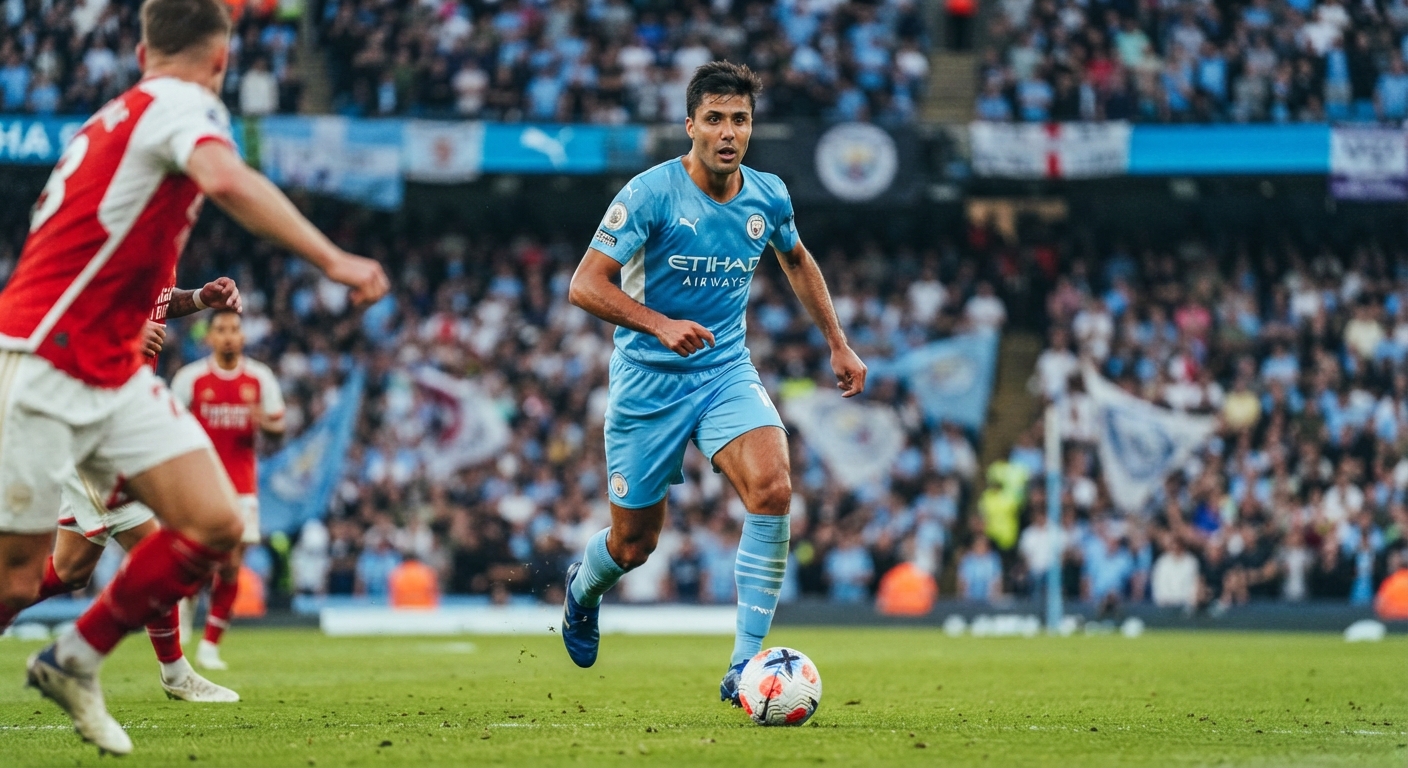
Some footballers announce their greatness. Others let the scoreline do it for them. Rodri, Manchester City's holding midfielder, belongs firmly in the second category — a player whose value is visible less in what he does than in what happens when he isn't there to do it. When he starts, City tend to win the games they are supposed to win. When he doesn't, as the ruinous 2023-24 stretch proved after a knee injury ruled him out for four months, City have a habit of losing matches they had no business losing.
The numbers behind his 2024 Ballon d'Or win have not softened with time, and they are the starting point for any serious conversation about him. Across a three-season sample, City's record with Rodri starting reads W94 D21 L8. Without him in that same window: W19 D8 L12. No individual player across Europe's top five leagues has produced a win-rate swing of that scale over a comparable sample size. The real debate was never whether he deserved the award — it was why a player carrying this much structural weight took so long to be recognised outside the analytics community and Pep Guardiola's inner circle.
The Numbers Behind the Control
Rodri's underlying data this season reads like a case study in efficiency married to output. His pass accuracy sits at 93.7 percent, the highest recorded by a Premier League midfielder, and he is averaging 9.1 ball recoveries per 90 minutes, comfortably the best mark in the division. His 8.4 progressive passes per 90 break opposition lines more consistently than any midfield peer in England, and he manages it while collecting yellow cards at a rate of just 0.21 per 90 — a near-spotless disciplinary record for a player whose entire job description involves stopping counter-attacks by whatever legal means necessary.
- Pass accuracy: 93.7% — highest of any Premier League midfielder
- Ball recoveries: 9.1 per 90 minutes, best in the division
- Progressive passes: 8.4 per 90
- Discipline: just 0.21 yellow cards per 90
- Goal contributions: 9 goals, 11 assists this season
- Win-rate split: W94 D21 L8 with him starting vs W19 D8 L12 without, across three seasons
Add nine goals and eleven assists from a deep-lying role and the picture is of a footballer contributing at both ends of the pitch without ever appearing to hurry. Since his arrival, City have collected four Premier League titles, a Champions League and a Club World Cup, and Rodri has been on the pitch for the vast majority of the biggest moments across every one of those campaigns.
City concede 0.7 goals a game with Rodri on the pitch. Without him, that figure doubles to 1.4.
The Tactical Engine That Makes Everything Flow
To understand what Rodri actually does, watch City without the ball. The instant possession is lost, he is the first line of recovery, reading the direction of the turnover and positioning himself to win the second ball before an opposition counter has time to develop. When City have the ball, he drops between the two centre-backs in the club's familiar back-three build, receiving under pressure with his back to goal and producing sixty-yard switches that shift the attack from flank to flank in under three touches. That defensive swing — 0.7 goals conceded per game in matches he starts, 1.4 in matches he misses — is a gap no amount of squad depth has managed to close.
"He is the most complete player I have ever managed." — Pep Guardiola, Manchester City manager
It is worth pausing on who is saying that. Guardiola has managed Xavi, Iniesta, Busquets, Lahm and Ribéry. That is not a throwaway line from a manager prone to hyperbole about his current crop — it is a considered judgement from someone with the widest possible frame of reference in the modern game. The sophistication in Rodri's reading of a match — knowing which opponent is stepping up to press, which channel has opened, which single pass triggers the break into the final third — is a football intelligence that stands out even inside a squad stacked with elite decision-makers.
A Season That Tested the Theory
City's run to the 2025-26 Champions League final gave Rodri's case its sternest examination yet. Real Madrid beat City in that final, a result that will sit uncomfortably alongside the individual numbers for a while yet, and it is a useful corrective to any suggestion that one midfielder can single-handedly guarantee silverware. Football remains a team sport, and even the most complete player Guardiola has ever coached could not out-argue a Madrid side playing the game of their lives on the night.
But a single defeat in a one-off final does not undo three seasons of evidence built match by match, metric by metric. Rodri's absence still costs City more than any other player's would, and his presence still sets a tactical standard the rest of the Premier League is chasing. That is not spectacle. It is the quietest, most repeatable form of dominance the English game currently has, and it is why City's biggest transfer priority every summer remains the same: keep the metronome ticking.