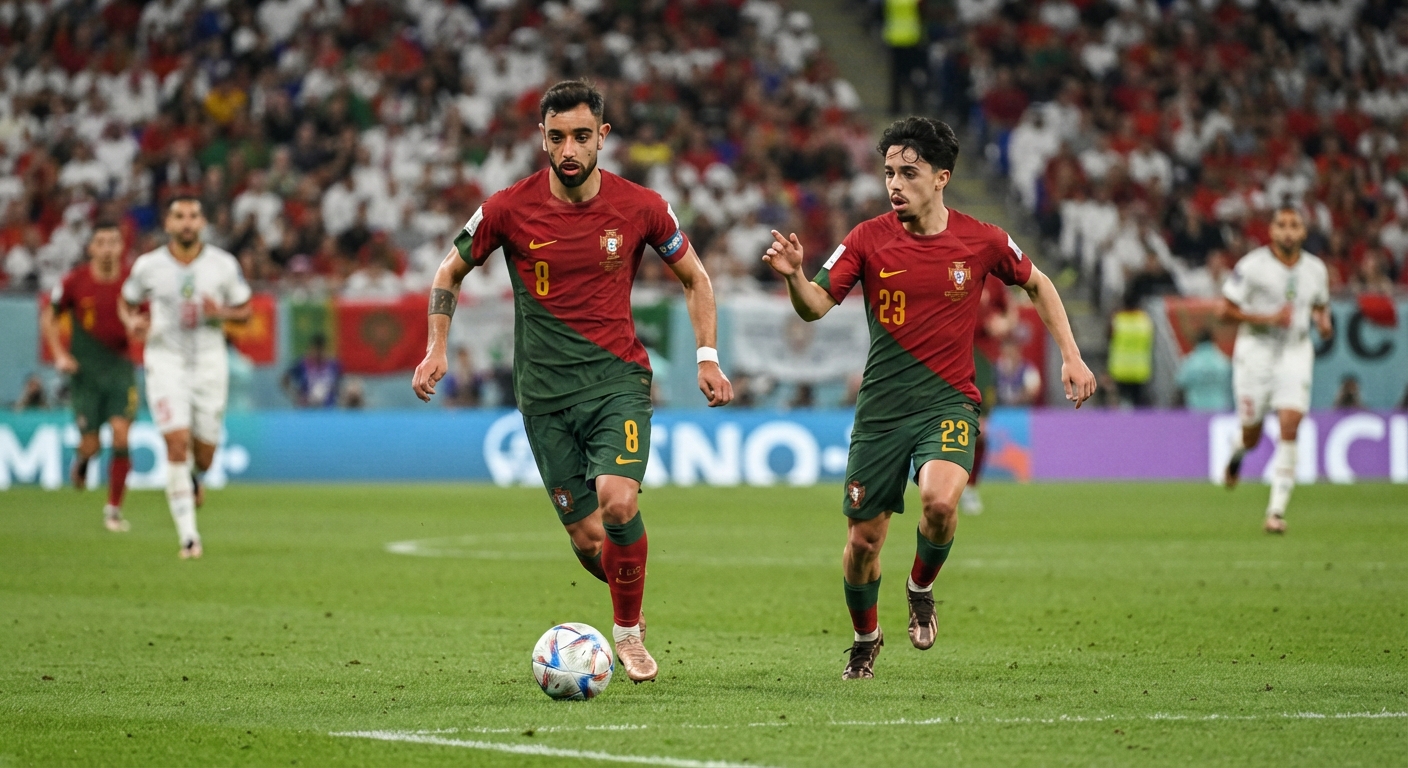
Cristiano Ronaldo is 41 and still Portugal's reference point whenever a camera pans to the bench or the tunnel, but this tournament has never really been about him. It belongs to the two players running the game eight yards behind and beside him: Bruno Fernandes and Vitinha. As the Round of 16 plays out across North America and heavyweights keep falling in the cruellest way possible, Portugal have quietly assembled the deepest, most balanced midfield of Ronaldo's five World Cups — and it is the reason they look built for a long run rather than a familiar early stumble.
Fernandes arrives at his peak
Bruno Fernandes has spent the last twelve months playing the best football of his career. He closed the 2025-26 Premier League season with nine goals and 21 assists, topping the division with 136 chances created and breaking a record that had stood since Thierry Henry and Kevin De Bruyne last set the bar. That form travelled with him into World Cup qualifying, where he scored a hat-trick in Portugal's 9-1 demolition of Armenia and finished the campaign with five goals and seven assists in his own right. Numbers like that used to belong to a support act orbiting Ronaldo. Now they belong to the player setting the tempo for the entire team.
What has changed is not just Fernandes' output but his role. Roberto Martinez has stopped asking him to chase the game from deep and instead lets him operate as the furthest-forward of Portugal's midfield three, arriving late into the box the way he does for Manchester United. It suits him. It also frees the players around him — chiefly Vitinha — to do the unglamorous work of actually running the match.
Portugal now have a midfield that can control ninety minutes without needing a moment of individual magic to bail it out.
Vitinha, the metronome
Vitinha does not make the highlight reels the way Fernandes does, and that is largely the point. At Paris Saint-Germain this season the 26-year-old added 11 assists to his usual diet of interceptions and progressive passes, but his real value shows up in the pace of a match rather than the box score. He can throttle a game down to a walk when Portugal need to protect a lead, or step it up when space opens behind a tired back four. Against opponents who set up defensively and dare Portugal to break them down — exactly the kind of side waiting in the knockouts — that control matters more than any single flash of skill.
It also matters tactically that Vitinha and Fernandes rarely occupy the same zone at the same time. Vitinha screens in front of the defence and dictates possession; Fernandes ghosts into the pockets further up. Bernardo Silva ties the two together, and Rúben Neves offers cover when either pushes on. It is the kind of structural depth that Portugal's earlier Ronaldo-era squads, reliant on individual moments from the front three, never really had.
- Bruno Fernandes, 2025-26 PL season: 9 goals, 21 assists, 136 chances created (league-topping)
- Fernandes in WC qualifying: 5 goals, 7 assists, including a hat-trick in a 9-1 win over Armenia
- Vitinha at PSG, 2025-26: 11 assists on top of his usual interception and progression numbers
- Supporting cast: Bernardo Silva links the two; Rúben Neves covers when either advances
- Ronaldo's age this tournament: 41, still Portugal's talismanic reference point off the ball
What the knockouts have already taught us
This has been a Round of 16 built on collapses under pressure. Germany went out on penalties to Paraguay. The Netherlands followed the same route against Brazil. Those exits are a reminder that raw talent counts for little once matches tighten and shootouts loom, and it is exactly why Portugal's midfield balance matters so much now. A team that can control tempo for ninety minutes is a team less likely to need penalties to survive in the first place.
England have already shown a version of this under Thomas Tuchel, hammering four past Croatia before grinding out a goalless draw with Ghana — evidence that the sides going furthest in this tournament are the ones who can adapt their rhythm match to match, not just the ones with the most star power on the team sheet. Portugal, with Fernandes and Vitinha dictating when to accelerate and when to sit on the ball, look built along the same lines.
"Bruno has stopped playing like he has to win the game on his own, and that is when he became our best player. Vitinha lets him do that because someone has to stay calm when everyone else wants to sprint." — Roberto Martinez, Portugal head coach
The Ronaldo question, answered differently
Portugal's challenge now is proving they can carry this control against the sort of physical, well-drilled opposition that has already ended two European heavyweights' summers. Vinicius Júnior's brilliance for Brazil — a brace against Serbia and another goal in the 3-0 win over Scotland — was a reminder that individual quality still decides knockout football at its sharpest edges. Portugal have that in Ronaldo, still capable of the occasional decisive touch off the bench or from a set piece. But for the first time in his international career, he is not the plan. He is the option behind the plan.
That is the real story of Portugal's tournament so far. Not a farewell tour for a 41-year-old icon, but a midfield pairing mature enough to make sure games never become a shootout lottery in the first place. Fernandes provides the end product Portugal always craved from their number ten; Vitinha provides the game management they never quite had behind him. Together they have built something Ronaldo's earlier, flashier squads could never claim — a team that wins by controlling matches, not just by winning moments.