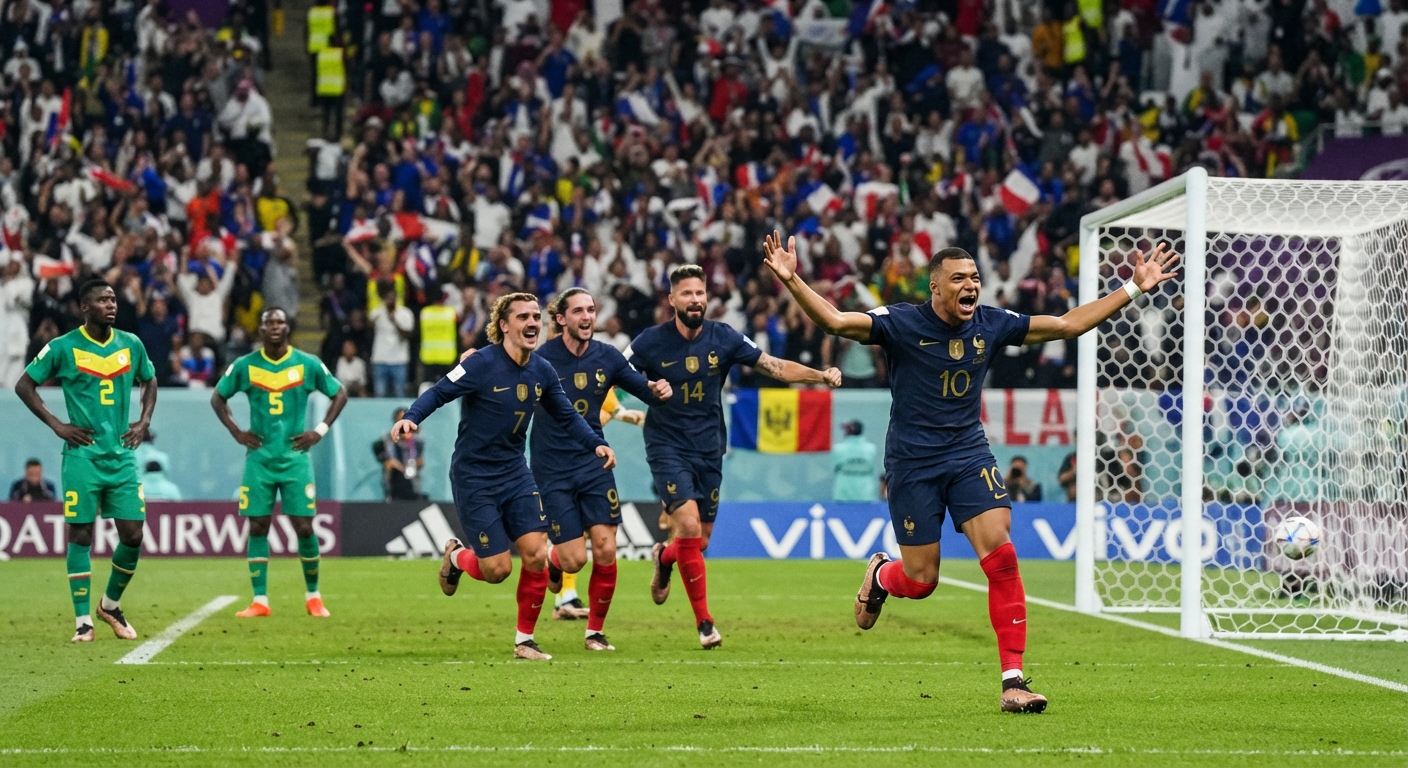
Kylian Mbappe does not sulk for long. Twenty minutes after a VAR review denied him a stonewall penalty, he had turned that grievance into two goals, and France had turned a shaky opener into a 3-1 win over Senegal at MetLife Stadium. It was not the cleanest performance from the reigning finalists, but it carried the one ingredient that has bailed them out repeatedly since 2018: a forward who treats injustice as fuel. Watching France's run since, all the way to this week's Round of 16, that night in New Jersey looks less like a scare and more like the moment the tournament tilted their way.
Mbappe Turns Anger Into Inspiration
The flashpoint arrived just before the break. Sadio Mane clipped Mbappe's standing leg inside the box, the France forward went down, and the referee waved play on. VAR took a long look and sided with the on-field call, ruling the contact insufficient. Replays suggested otherwise, and Mbappe's reaction as he walked off at halftime, arms spread, jaw set, told its own story.
Whatever Didier Deschamps said in that dressing room worked. Four minutes into the second half, Mbappe picked the ball up wide, cut inside past two defenders in a run that started near the touchline and ended with a clinical finish across the goalkeeper. It was the kind of solo goal that needs no commentary. His second, on the hour, came from range, a low, precise strike that gave Edouard Mendy no chance and effectively ended the contest as anything but a formality.
- Final score: France 3-1 Senegal, MetLife Stadium
- Mbappe's night: two goals, three shots on target, 86% pass completion
- Career mark: eight World Cup goals across the last two tournaments combined
- Senegal's reply: Boulaye Dia header from a second-half corner
- Denied moment: penalty appeal for a foul by Sadio Mane, ruled insufficient contact by VAR
- Missed chances: Ismaila Sarr scuffed a six-yard finish; Nicolas Jackson's rebound ruled offside
Three shots on target from as many real chances, an 86 percent pass completion rate, and two goals that swung a World Cup opener. Mbappe has now scored eight goals across the last two World Cups combined, and the pattern is becoming impossible to ignore: when France look stuck, he is usually the one who unsticks them. Since his breakout at 19 in Russia, he has rarely gone a major tournament without producing the moment a team needs. Senegal simply became the latest opponent to find that out.
He was denied once by the letter of the law and answered twice with the force of his talent.
Senegal's Wasted First-Half Superiority
For 45 minutes, this did not look like a match Senegal would lose. Aliou Cisse's side pressed France's back line high, won the ball back in dangerous areas, and created the better chances of the opening period. Ismaila Sarr should have scored from six yards after a low cross picked him out unmarked, but he scuffed the finish wide with the goal gaping. Nicolas Jackson thought he had done better still, turning in a rebound only for the offside flag to cut the celebration short.
Those two moments will sting more with hindsight. France's back four, missing its usual cohesion in the opening exchanges, looked genuinely unsettled by Senegal's movement between the lines. Dia and Jackson rotated positions cleverly enough to drag defenders out of shape, and Senegal's midfield won more second balls than anyone at MetLife Stadium expected. It was, for large stretches, the more coherent team.
What Senegal lacked was conversion. Chances created do not appear on a scoreboard, and against a team with Mbappe's finishing quality, profligacy in front of goal is punished eventually. Senegal pulled a goal back in the second half through Dia, a header from a corner that briefly suggested a way back into the match, but by then Mbappe had already put the result out of reach.
Deschamps Finds Answers Under Pressure
Credit belongs to Deschamps for the halftime reset. France came out for the second half with a higher defensive line and quicker circulation, starving Senegal of the space they had exploited in the opening period. Aurelien Tchouameni began dropping deeper to collect the ball from the center-backs, giving France an extra body to build through midfield rather than relying on long balls forward. That shift bought Mbappe more service in dangerous areas, and he made it count almost immediately.
"You saw a player who was hurt and a team that knew how to use that. Kylian doesn't need much of an invitation, but tonight we gave him one and he took it twice." — Didier Deschamps, France manager
It was a reminder of why Deschamps remains one of the more pragmatic operators in the international game. He does not always get the tactics right from the first whistle, but few managers adjust as ruthlessly at the break, and few squads have a player capable of making that adjustment look inevitable.
A Statement That Still Echoes
Weeks on, with France into the Round of 16 and the knockout rounds now the only currency that matters, that Senegal night reads as the template rather than the exception. A slow start, a refereeing decision that could have derailed the mood, and a captain-in-waiting who simply refuses to let a grievance become a setback. Senegal, for their part, leave the tournament as a cautionary tale about the gap between creating chances and taking them, the kind of story that will follow Cisse's group through the post-mortems back home.
For France, the lesson was simpler and has been reinforced every round since: give Mbappe a reason to be angry, and he will find a way to make someone else regret it.