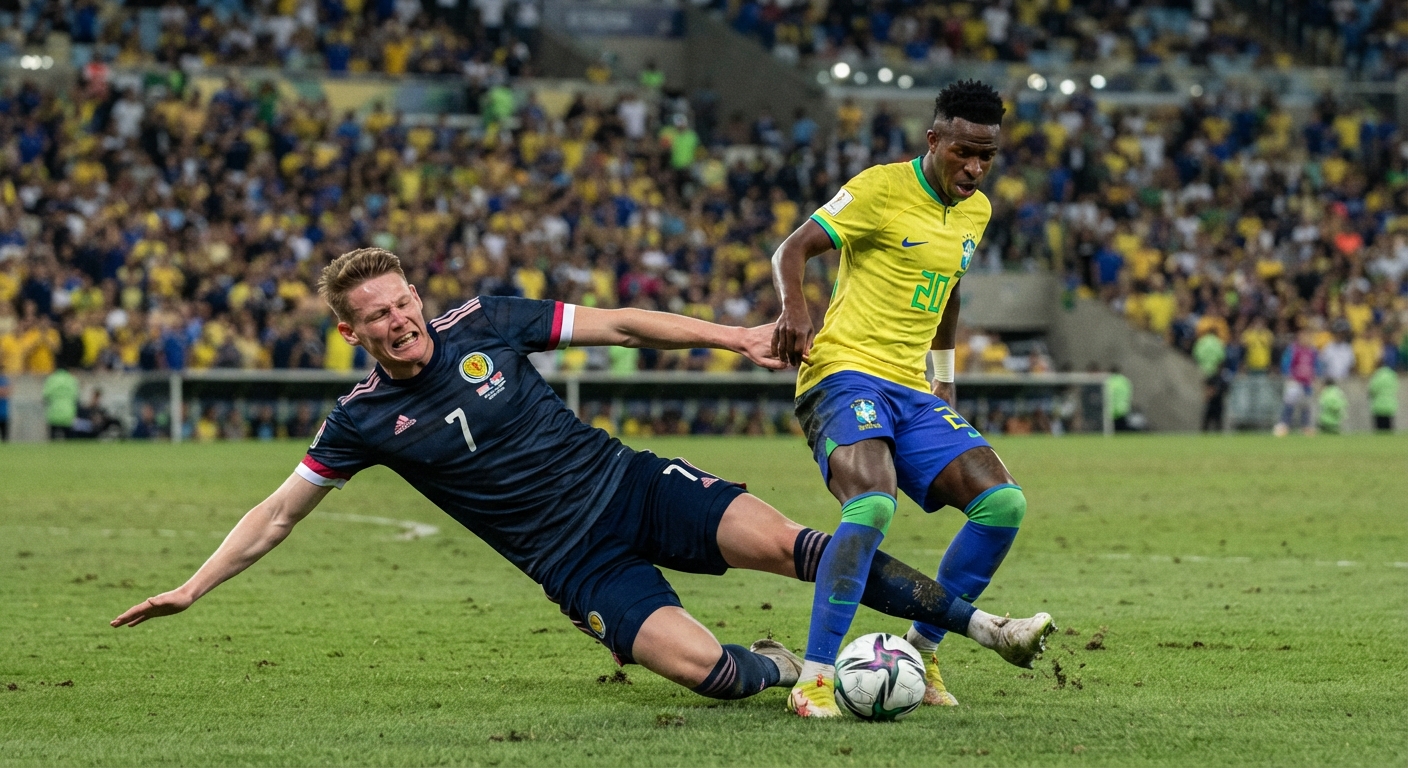
Scott McTominay walked off the pitch in tears, and nobody in a dark blue shirt begrudged him that. Scotland's first World Cup in 28 years ended the way most people feared it might once the draw paired them with Brazil: 3-0, comprehensive, with Vinicius Junior doing to tired legs in the final third what he has done to defences all tournament. But the story of this Scotland side was never going to be written in that scoreline alone, and McTominay's tournament deserves to be read on its own terms.
The Napoli midfielder arrived at the finals carrying a nation's expectation on a scale few Scottish players have ever known. A double against Spain in qualifying had already turned him into folk-hero territory back home, and pundits kept waiting for a repeat performance under the brightest lights. It never quite arrived in the way the highlight reels wanted. What arrived instead was something more durable: a player who covered every blade of grass, closed down passing lanes Brazil's midfield never expected to be closed, and kept Scotland in games longer than their overall quality probably deserved.
The Numbers Behind a Quiet Campaign
Strip away the scoreline against Brazil and McTominay's underlying numbers across the group stage stand up to scrutiny. He completed above 90% of his passes in two of his three appearances, a remarkable figure for a box-to-box midfielder asked to break lines rather than just recycle possession. Against Brazil specifically, he covered more distance than any other Scotland player on the pitch, chasing a game that had already slipped away by half-time. It is the kind of stat that tells you about character rather than outcome, and Steve Clarke's players have leaned on both all tournament.
He was still sprinting into Brazil's box in the 80th minute of a game that had been decided an hour earlier.
McTominay was not a passenger in defeat. He had Scotland's best chance of the first half, a low drive that Brazil's goalkeeper did well to smother, and he was still making forward runs deep into the second half of a match long since settled. Vinicius struck as Brazil broke on the counter, moments after McTominay had committed bodies forward in search of a way back into the game. That is the trade-off international football against the world's best sides always demands, and it is one Scotland accepted knowingly.
- First World Cup appearance: since 1998, a 28-year wait ended
- Group stage exit: lost 3-0 to Brazil, Vinicius Junior among the scorers
- McTominay's qualifying impact: a decisive double away to Spain
- Pass completion: above 90% in two of three group matches
- Distance covered vs Brazil: more than any other Scotland outfield player
- Manager: Steve Clarke, in charge for the whole qualifying cycle
Clarke's Faith Never Wavered
Steve Clarke has built his entire Scotland project around trusting players who do not need the ball at their feet every ten seconds to influence a match, and McTominay has been the clearest example of that thinking for three years running. Speaking after the final whistle in the group-stage decider, Clarke pointed to exactly the qualities that rarely show up on a stat sheet.
"This tournament will not be remembered for one scoreline against the best team in our group. It will be remembered for the fact my players never stopped competing against opponents with vastly superior individual talent. Scott gave us everything he had, right to the final whistle." — Steve Clarke, Scotland manager
That framing matters when assessing McTominay's contribution honestly. Brazil pressed high, moved the ball with a speed that punishes even a fraction of a second's hesitation, and still Scotland's midfield managed spells of genuine control in the middle third. It simply was not enough against a front line built around Vinicius Junior and a supporting cast now through to the Round of 16, with knockout fixtures being played across the United States, Mexico and Canada this week.
What the Exit Means for Scotland
Scotland's elimination stings more because of how it happened than the fact it happened at all. Few inside the camp expected to top a group containing Brazil, and the realistic aim from the start of qualifying had always been to give the country a first taste of World Cup football in 28 years and to be competitive rather than embarrassed. On that measure, McTominay and his teammates delivered. They were not overrun in every match, and their captain's willingness to run himself into the ground against the tournament's most explosive attacker said everything about the standard Clarke has instilled.
The wider Round of 16 picture only sharpens the contrast. Germany are out on penalties to Paraguay, the Netherlands have gone the same way against Brazil's group-stage conquerors, and results across the knockout draw keep proving that no reputation guarantees safe passage anymore. Scotland were never going to be immune to that reality against Vinicius and company, but McTominay's tournament suggested a squad capable of testing sterner opposition than a first-timer's underdog tag usually allows.
A Foundation, Not a Full Stop
What Scotland take from this World Cup is less about the final scoreline and more about the template McTominay laid down for a golden generation still finding its ceiling. A 28-year gap between appearances will not close overnight into sustained qualification, but a captain who ran every blazing yard against Brazil, in a stadium far from home, with a nation's hopes on his shoulders, gives Clarke's successors something concrete to build from. Vinicius ended the dream on the scoreboard. He did not diminish what McTominay built to get Scotland there in the first place.