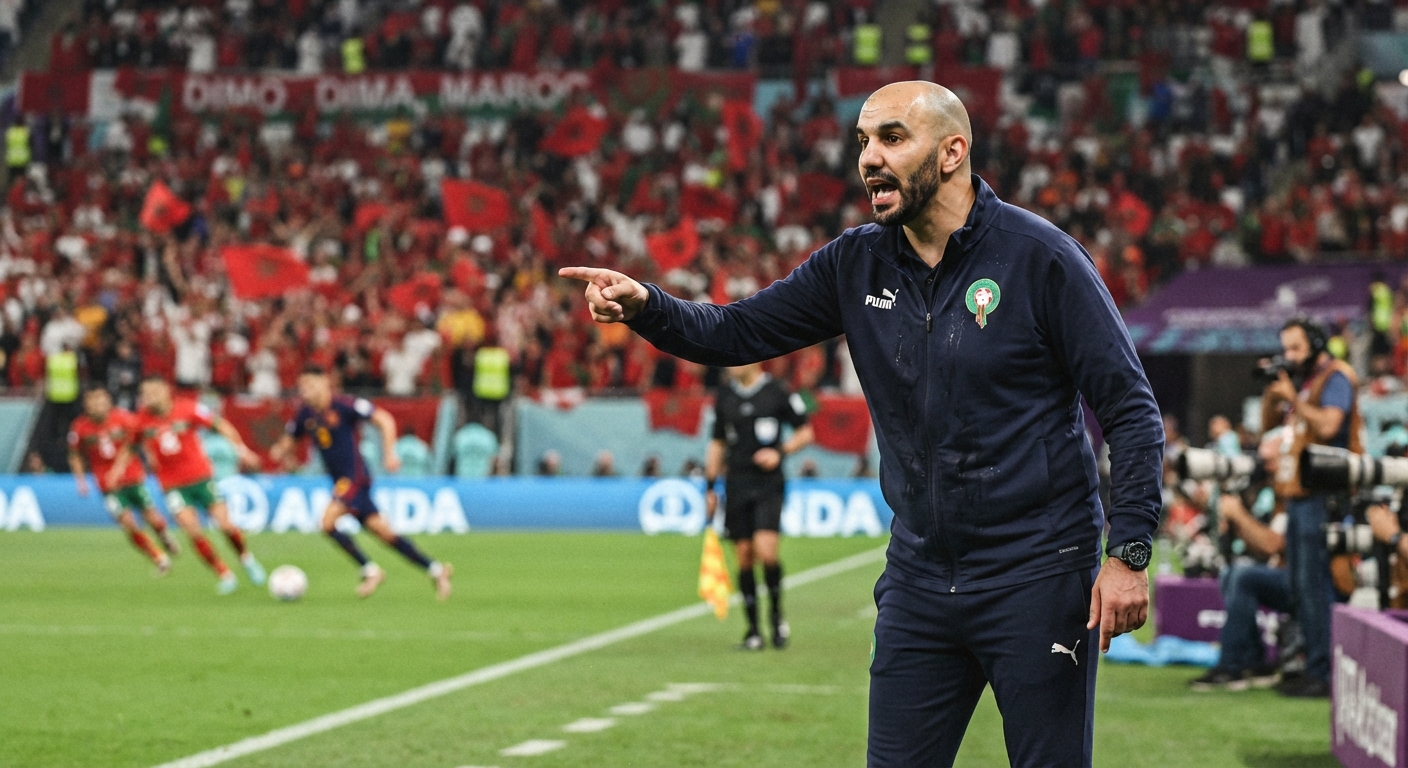
When Morocco beat Portugal 1-0 in the quarter-finals of Qatar 2022 to become the first African nation to reach a World Cup semi-final, something shifted in global football. It was not just the result — it was the manner of it. Disciplined, physical, tactically brilliant and emotionally charged, Walid Regragui's side gave the world a template for how an African nation could compete with and beat the best. Four years on, in the humid evenings of the United States and the passionate stadiums of Mexico, that template has been refined rather than abandoned. Morocco arrive at the round of 16 of World Cup 2026 looking like the finished version of the team that captivated the world in Doha, ninety minutes away from a quarter-final that would put them within touching distance of matching, or bettering, that Qatar run.
A Group Stage Built on Control
Morocco's passage through the group phase was less dramatic than four years ago but no less impressive in its efficiency. They controlled possession in patches, ceded it willingly in others, and never once looked rattled — a hallmark of Regragui's management. An opening win built on a set-piece goal, a hard-fought draw against a well-organised European side, and a comprehensive victory in the final group match saw them through as group winners without conceding more than once in any single fixture. The round of 32 brought a tense, low-scoring win settled by a moment of individual brilliance, and now the round of 16 awaits — the same stage at which so many pre-tournament fancies have already fallen in Round 2026, with Germany dumped out on penalties by Paraguay and the Netherlands eliminated by Brazil in the same fashion.
- Group stage record: won two, drew one, group winners
- Goals conceded: no more than one in any single group match
- Round of 32: narrow win settled by individual brilliance
- Key man: Achraf Hakimi, more direct goal involvements already than in the full 2022 campaign
- System: mid-to-low block with coordinated pressing triggers
- Manager: Walid Regragui, architect of Qatar 2022's run to the semi-finals
The Low Block, Reimagined
The foundation of it all remains Regragui's mid-to-low block, but it is no longer the purely reactive shape that frustrated Spain and Portugal in Qatar. Morocco still invite pressure in wide areas and compress centrally, daring opponents to work the ball through a five-man defensive line shielded by two disciplined holding midfielders, but the trigger points for pressing have sharpened considerably. Where in 2022 Morocco were content to sit deep for long stretches, in 2026 they press in coordinated bursts the moment an opponent's centre-back turns their body the wrong way, and their wing-backs have become the single most important tactical innovation in the side. Whoever occupies those flank positions is now asked to defend as an auxiliary centre-back one moment and overlap as a winger the next, stretching the pitch to a width few teams can live with.
Morocco have conceded fewer clear-cut chances per ninety minutes than any other side left in the draw.
It is a system that demands extraordinary fitness and game intelligence, and the round of 16 will be its sternest examination yet against opposition that will have studied every clip of it. If Morocco can defend their box the way they have all tournament, the counter-attacking weapons up front should do the rest.
Hakimi's Evolution
No individual embodies that tactical evolution better than Achraf Hakimi. Still, at his peak, arguably the finest right-back in world football, Hakimi has been deployed with even greater licence to attack than he was in Qatar, and the numbers reflect it — he has already contributed more direct goal involvements this tournament than he managed across the entirety of the 2022 campaign. Regragui trusts him to invert into midfield when Morocco are building patiently, to bomb the width when they break, and to drop into a back three when possession is lost, a positional fluidity that few full-backs anywhere in the world are asked to execute, let alone master.
"We are not the surprise package anymore. Everyone knows what Morocco can do now, so we have to find new ways to hurt teams. That is the challenge of this round of 16 — evolving again, under more pressure than Qatar ever gave us." — Walid Regragui, Morocco head coach
Alongside Hakimi, the squad has evolved meaningfully since Qatar. A core of experienced heads — Hakim Ziyech's craft returning from deep, the physical presence anchoring central midfield, the goalkeeping stability behind it all — has been supplemented by a younger generation blooded in Europe's top leagues over the past four years, giving Regragui a bench that can change games rather than merely see them out. That depth, more than any single individual, is the difference between the Morocco of Doha and the Morocco of 2026.
The Stakes Beyond the Pitch
What made Qatar 2022 resonate so far beyond football was the sense of an entire continent, and much of the Arab world, seeing itself represented on the biggest stage. That backing has not diminished with distance from Morocco's own soil — travelling support has again transformed neutral venues into de facto home fixtures, and the noise inside the stadium has become as much a part of Regragui's game plan as anything drawn on a tactics board. Win the round of 16, and Morocco are one victory away from a second successive World Cup semi-final, a feat no African nation has come close to touching. Regragui built a team in Qatar that changed how the world saw African football; this version, deeper and more tactically literate, is built to make sure that moment was not a one-off.