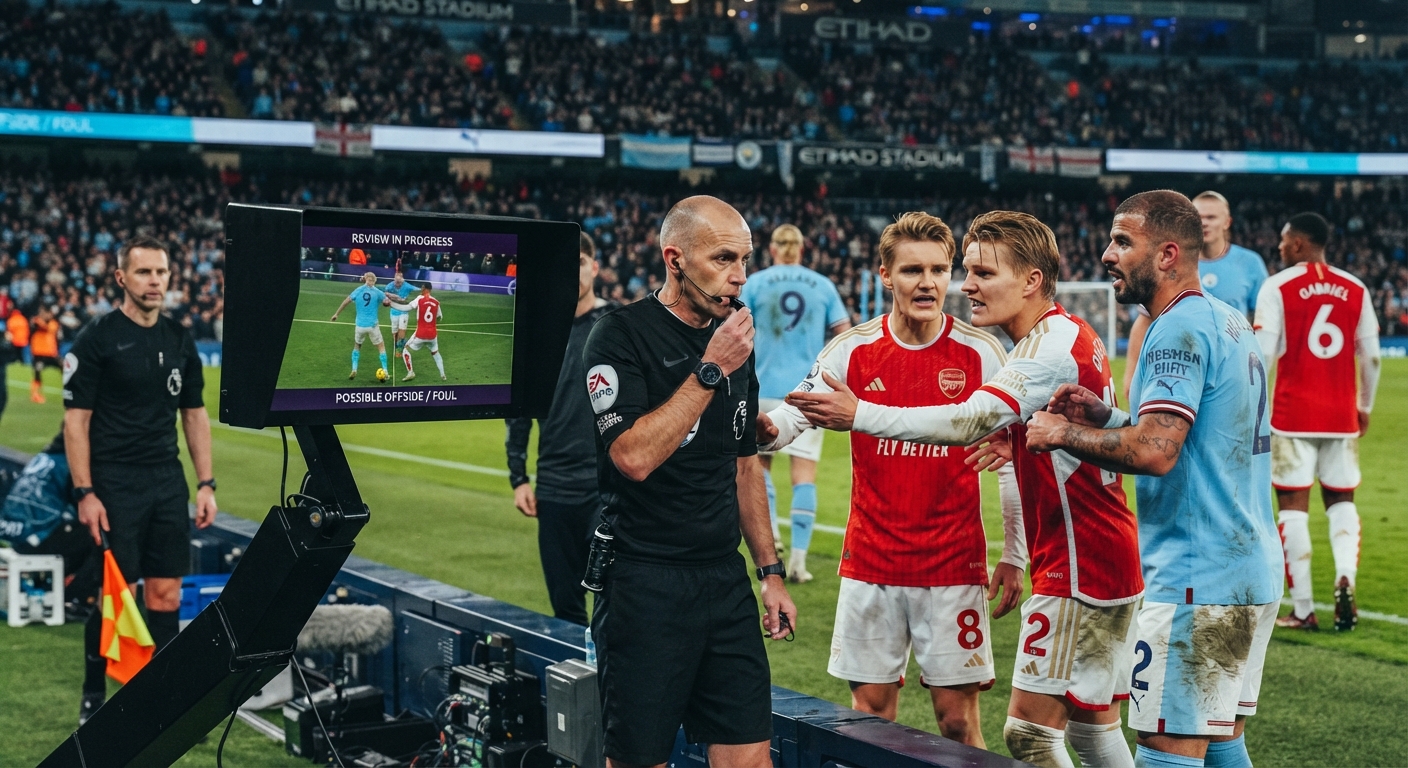
The Speed Was Never the Problem
Eight years after its World Cup debut in Russia, VAR arrived in North America with a genuine technical upgrade. Semi-automated offside technology, tracking 29 points on every player's body dozens of times per second, has cut the average offside review from over a minute to under twenty seconds. FIFA has sold this as progress, and on the stopwatch it is. But the Round of 16 in 2026 has exposed what critics said all along: shaving time off a review does nothing to fix a decision that was contestable in the first place.
A faster wrong answer is still wrong. It just annoys people more efficiently.
Germany's exit on penalties to Paraguay and the Netherlands' shootout defeat to Brazil were both settled the old-fashioned way, with no camera able to soften the blow. But the matches that got them there were littered with stoppages, the pointing to the ear, six-figure crowds waiting in silence for a giant screen to render a verdict. That silence is the real cost of VAR, and no algorithm has found a way to shorten it to zero.
Millimetres, Armpits, and the Death of the Onside Goal
No single application of VAR has generated more resentment than the offside freeze-frame. A striker's shoulder, an arm trailing behind the run, a toe a fraction ahead of the last defender — none of it capable of producing an advantage a human eye could ever detect, yet all of it enough to strip a goal from the scoreboard. The offside law was written for an era when officials judged distance by eye from thirty yards away. It was never built to survive contact with a system that can measure gaps smaller than a football's own seam.
That is the paradox nobody at FIFA wants to say out loud: the more accurately you can enforce a law, the more obvious it becomes that the law itself was never meant to be enforced with that kind of precision. Semi-automated tracking has made the calls faster. It has not made them feel any more like justice, and pundits working England's matches against Croatia and Ghana have said as much on air, even in games their side won or drew comfortably.
- Tracking points per player: 29, captured dozens of times per second
- Average offside review time: cut from over a minute to under 20 seconds
- Germany: eliminated on penalties by Paraguay
- Netherlands: eliminated on penalties by Brazil
- England: beat Croatia 4-2, drew 0-0 with Ghana, through to Round of 16
- Scotland: lost 3-0 to Brazil, Vinicius Jr among the scorers
Handball Still Defies a Straight Answer
Ask a room of coaches to define handball and you will get a room full of different answers, and that was true before VAR and remains true now. The rule has drifted from "deliberate contact" to "unnatural silhouette" to a hybrid nobody can recite consistently, and every governing body from FIFA down to individual leagues has issued its own guidance note trying to clarify it. VAR does not resolve that confusion. It amplifies it, because a video review forces referees to give a definitive yes-or-no answer to a question that was designed, by the wording of the law itself, to stay a matter of interpretation.
Thomas Tuchel has been characteristically blunt on the subject since taking the England job, arguing publicly that penalty-box contact decisions should be left to the referee's first instinct far more often than they currently are. He is not alone. Managers across the tournament, including several whose teams have already gone home, have made the same complaint: VAR was sold as a tool for correcting howlers, not for re-litigating every marginal shove in a crowded box.
"We ask the referee to make a call in real time, then we spend four minutes proving he was wrong about two centimetres. That is not correcting an error. That is manufacturing doubt." — Thomas Tuchel, England manager
The Stakes Get Higher in the Knockouts
Everything about VAR controversy intensifies once the group stage ends. There is no second match to make up for an injustice, no goal difference cushion to absorb a bad call. Brazil's 3-0 win over Scotland, with Vinicius Jr among the scorers after his brace against Serbia earlier in the tournament, was straightforward enough that video review barely featured. But that is precisely the point critics make: VAR is judged not by the games where it is invisible, but by the ones where a single freeze-frame decides who plays on and who flies home.
Scotland's players will not remember this tournament for a marginal review. Some other team, in some other knockout tie between now and the 19 July final at MetLife Stadium, almost certainly will.
A Technology Without an Ending
The uncomfortable truth is that VAR was never going to be finished at a World Cup, because the problems it exposes are not technical. Faster cameras cannot decide what counts as an unnatural arm position. More tracking points cannot tell a referee whether a shove was worth a penalty or just a foul worth shrugging off. Those are judgment calls dressed up as measurements, and no amount of semi-automation changes that.
FIFA fixed the clock. It never touched the argument.
What the Round of 16 has actually shown is a system operating exactly as designed, just quicker about it. The reviews that used to take ninety seconds now take twenty, and the outrage that used to build slowly now arrives almost instantly, fully formed, before the players have even finished their celebration or their protest. Whether that counts as progress depends entirely on what you thought VAR was for in the first place. If it was speed, mission accomplished. If it was certainty, the search continues — and it will still be going long after this tournament's trophy has been lifted.